Horse Racing Betting Strategy: Data-Led Approaches for UK Punters
 Available in US
In 2020, after five years of treating horse racing betting as a semi-serious hobby, I sat down and audited my entire betting record. Every bet, every result, every pound in and out. The exercise took a weekend, and the conclusion was brutal: I was profitable in roughly a third of the months and unprofitable in the rest, with the net result hovering around breakeven after accounting for promotional bonuses. I was not losing money, but I was not making it either – and the gap between my knowledge of the sport and my ability to translate that knowledge into returns was embarrassingly wide. The strategy overhaul that followed is the foundation of everything I do now, and the principles are simpler than I expected.
Identifying Value: What It Means and How to Spot It
Value is the most overused and least understood word in betting. Every tipster claims to find it. Every promotional page promises it. But the definition is precise and mathematical: a bet has value when the probability of the outcome occurring is higher than the probability implied by the odds. If a horse has a genuine 25% chance of winning and the odds imply a 20% chance (decimal 5.00), the bet has positive expected value. If the odds imply a 30% chance (decimal 3.33), it does not, regardless of how good the horse looks on paper.
The challenge is obvious: how do you determine the “genuine” probability of a horse winning? The honest answer is that you cannot do so with certainty. What you can do is develop a framework for estimating it that is more accurate than the market’s pricing in specific, repeatable situations. That is where strategy enters.
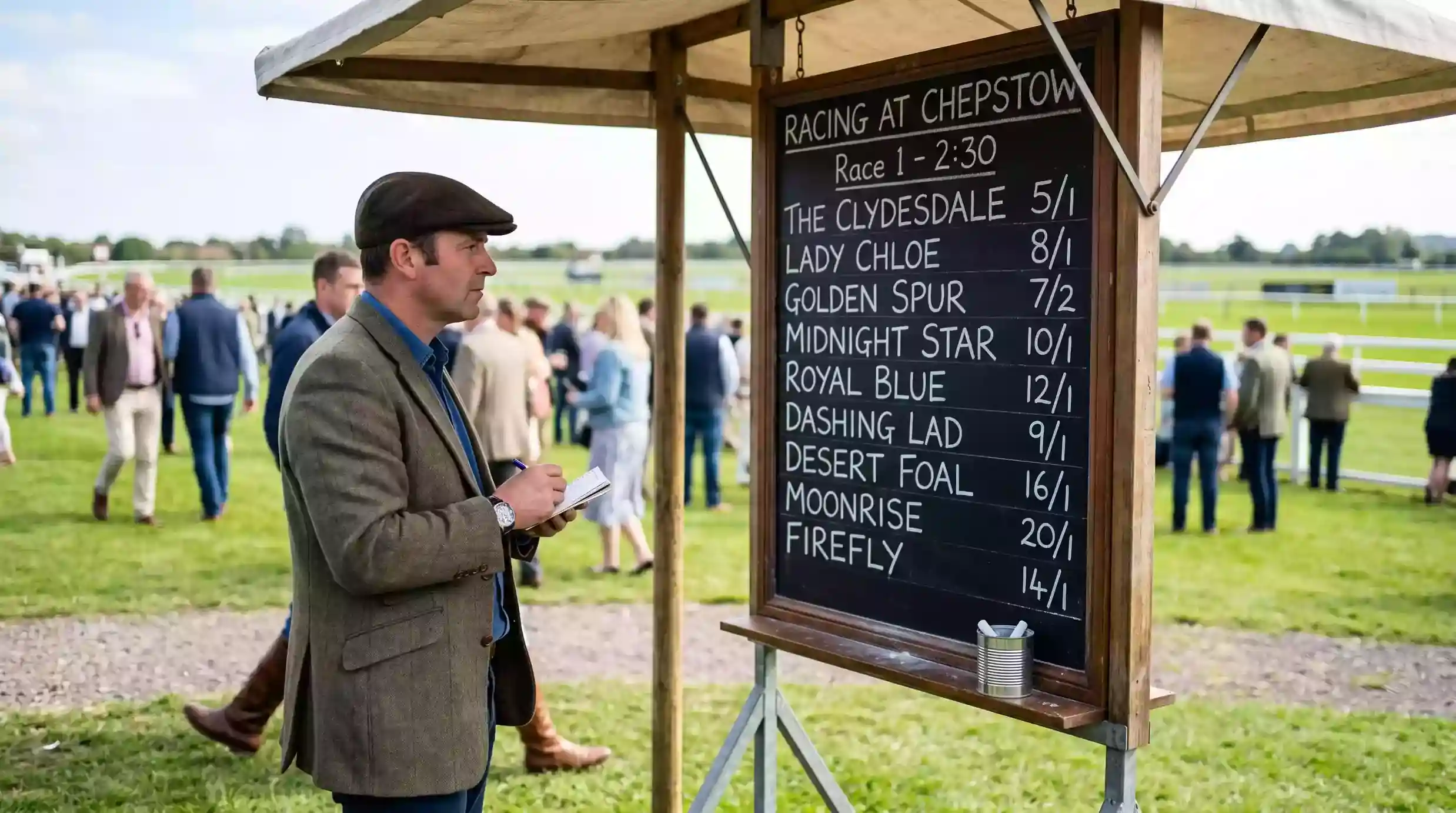
My approach to identifying value starts with the form book rather than the odds. I analyse a race, assess each runner’s strengths and weaknesses, and assign a rough probability ranking before looking at the prices. Only then do I compare my assessment with the market. If my analysis suggests a horse has a 20% chance and the bookmaker is offering 8/1 (implied probability 11%), I have identified a potential value bet. If the same horse is 3/1 (implied probability 25%), the market has priced it more aggressively than my assessment warrants.
The GGY from online horse racing betting reached 766.7 million pounds in 2024/25, and that entire figure represents the aggregate margin between what punters bet and what they receive back. Beating the margin consistently requires finding spots where the market has mispriced a runner, and the only way to find those spots is through independent analysis. Relying on tips, gut feeling, or market signals alone will not produce sustained profit because those inputs are already reflected in the odds.
Bankroll Management for Horse Racing Bettors
I once had a conversation with a former professional punter who told me that his edge in the market was worth approximately 3% over a large sample. Three percent. That is the margin that separated him from breakeven. Now consider what happens to a 3% edge if you stake inconsistently – betting 5% of your bankroll on a whim one day and 0.5% the next, or doubling down after a losing streak. The edge gets consumed by variance, and the discipline that would have converted it into profit over time is destroyed by emotional staking.
The simplest bankroll management system that works is level staking: betting the same amount on every selection, regardless of confidence level. This removes the temptation to over-stake on “certainties” that turn out to be nothing of the sort. My level stake is 2% of my betting bankroll per bet. If the bankroll grows, the stake grows proportionally. If it shrinks, the stake shrinks too. This self-correcting mechanism prevents catastrophic loss during cold streaks and allows the bankroll to compound during hot ones.
More sophisticated systems exist – Kelly criterion staking, proportional staking based on perceived edge, tiered staking by confidence level – but my experience is that the added complexity rarely produces meaningfully better results than simple level staking. The primary value of bankroll management is not optimisation; it is survival. A punter who survives a losing month with their bankroll intact will have the opportunity to recover. A punter who stakes recklessly during that same month will not.
The Case for Specialising in a Race Type or Track
Generalists in horse racing betting face an information disadvantage that is almost impossible to overcome. There are roughly 1,500 race meetings per year in the UK across 59 courses, encompassing flat racing, hurdles, steeplechases, bumpers, and all-weather fixtures. Nobody can maintain deep expertise across all of it. The punters who produce consistent returns tend to specialise – narrowing their focus to a specific race type, distance range, or course where their accumulated knowledge creates a genuine edge over the market.
I specialise in two-mile hurdle races and competitive handicap chases over two and a half to three miles. These are the race types where my understanding of pace, form, and ground impact is deepest, and where my analysis most frequently identifies discrepancies between my assessment and the market price. On flat maiden races or sprint handicaps at Lingfield, I have no edge – the form is opaque, my knowledge is shallow, and betting in those races would be indistinguishable from gambling randomly.
Turnover on core fixtures – the everyday racing that fills the midweek calendar – dropped 14.4% year-on-year according to BHA data, while premier meetings held steady. This divergence tells you something important about market efficiency. The big meetings attract professional money, sophisticated modelling, and intense media scrutiny, making the odds tighter and harder to beat. The everyday fixtures, with their lower liquidity and less analytical attention, offer wider pricing and more opportunities for the specialist who has done the work. Finding your niche within the everyday programme is one of the most underrated strategic decisions a punter can make.
Strategic Mistakes That Cost Punters Money
After nine years of analysing both markets and my own behaviour, I can identify the patterns that destroy betting bankrolls with depressing regularity.
Chasing losses is the most common and the most destructive. A bad afternoon leads to increased stakes in the evening, which leads to further losses, which leads to a disastrous live-betting session at 8pm on an all-weather meeting you would never normally touch. The cycle is predictable, and the only defence is a pre-committed daily loss limit that triggers a hard stop.
Overconfidence after a winning streak is the mirror image of chasing losses, and it is almost as costly. Three winners in a row creates the illusion that you have cracked the code, and the next bet – placed with inflated confidence and possibly an inflated stake – brings reality crashing back. Winning streaks are variance, not validation. Treat them accordingly.
Vaughan Lewis, the former Chief Strategy Officer at Evoke, made a point that applies to punters as much as operators: as a bettor, you cannot sustain your approach if the marketplace keeps moving against you. Lewis was talking about regulatory pressure, but the principle translates. If your betting strategy is producing consistent losses over a meaningful sample – 200 or more bets – the market is telling you that your edge does not exist, and doubling down on the same approach is not determination; it is denial.
The single most profitable strategic change I ever made was learning to pass on races where I had no strong opinion. Sitting out is not a failure – it is capital preservation. The best racing days I have had financially are not the ones where I backed five winners; they are the ones where I backed two winners and passed on ten races where I would have lost.
Strategy as Process, Not Formula
There is no magic formula for horse racing betting. Anyone who tells you otherwise is selling something. What exists is a process: analyse form independently, compare your assessment with the market, bet when the price exceeds your estimated probability, stake consistently, track your results, and refine your approach based on the data. That process, executed with discipline over months and years, is the closest thing to a “strategy that works” that this sport offers.
The UK online gambling market is projected to reach between 13 billion and 15 billion dollars by the early 2030s, which means the industry’s ability to extract money from punters is not diminishing – it is growing. The strategic punter’s job is to be in the minority that gives less back than the average. Not through luck, not through tips, but through a systematic approach to value identification, risk management, and self-discipline. It is not glamorous work. But it is the only work that consistently produces results across horse racing betting.
Is there a proven strategy for horse racing betting?
No single strategy guarantees profit, because horse racing outcomes involve irreducible uncertainty. However, a consistent process of independent form analysis, value identification (betting when odds exceed your estimated probability), disciplined bankroll management, and specialisation in specific race types can produce positive returns over large samples. The key is treating betting as a repeatable process rather than a series of isolated decisions.
How much of my bankroll should I stake per bet?
A common approach is level staking at 1% to 3% of your total betting bankroll per bet. This limits the impact of any single loss while allowing the bankroll to grow during profitable periods. At 2% per bet, a losing streak of 20 consecutive bets – extreme but possible – would reduce your bankroll by roughly one third rather than eliminating it, preserving your ability to recover.
Created by the ”Horse Racing bet Website” editorial team.