Grand National Betting Sites: Best Bookmakers for Aintree
 Available in US
The Grand National is the one race that turns the entire country into punters. Office sweepstakes, pub bets, grandparents who have not wagered all year – everyone has a horse on the first Saturday in April. I have watched the race from the stands at Aintree, from a betting shop in central London, and from my own sofa with three screens running. Each time, the same truth holds: this is the most chaotic, unpredictable, and emotionally draining race in the calendar, and the betting sites you choose to use on the day affect your experience and your returns more than most people realise.
Horse racing betting participation spikes to roughly 7% of UK adults during peak season, and the Grand National drives a significant portion of that seasonal surge. This is the one race where the betting market is flooded with casual money, and the dynamics that creates – from distorted odds to unusually generous promotions – make the National a unique proposition for the informed punter.
Best Betting Sites for the Grand National
Rather than ranking specific operators, I want to outline what you should be looking for when choosing where to place your Grand National bets. The features that matter for this particular race are not identical to what matters for everyday racing, because the National’s 40-runner field over four miles and 30 fences creates specific challenges and opportunities.
First, place terms. The Grand National is one of the few races where some bookmakers pay five or even six places on each-way bets. Given the size of the field and the attrition rate – horses fall, refuse, get pulled up – each-way betting on the National is a fundamentally different proposition depending on how many places your bookmaker is paying. The difference between three places and six places on a 40-runner race is enormous in expected-value terms, and this single factor should be the primary driver of your bookmaker choice for this race.
Second, best odds guaranteed. Taking an early price on a Grand National runner and knowing that if the SP drifts out you will receive the higher price is a genuine edge. Not all operators maintain BOG on the National – some restrict it to their standard racing coverage – so check before assuming you are covered.
Third, live streaming and in-play options. The Grand National is a long race – over nine minutes – and the ability to watch it live through your betting site while having access to in-play cash-out options gives you flexibility that a static bet does not. Some platforms offer partial cash out during the race, allowing you to lock in a portion of your returns while leaving the rest riding.
Fourth, market depth. The operators that price up every runner in the ante-post market, offer forecast and tricast betting on the National, and maintain Tote pool access alongside fixed odds give you the broadest range of wagering options. On a race this unpredictable, having multiple betting avenues available is an asset.
Grand National Each-Way Place Terms Compared
This is where the real money is made or left on the table. Standard each-way terms on a handicap with 16 or more runners pay three places at one quarter the odds. For the Grand National, with its field of 40, many bookmakers extend this to four, five, or six places – and some offer one fifth the odds rather than one quarter on the place portion.
The maths is significant. Consider a horse at 20/1 with a ten-pound each-way bet (twenty pounds total). At standard three-place terms (1/4 odds), the place return if it finishes third is 10 plus (10 times 5/1) = 60 pounds. At enhanced six-place terms (1/5 odds), the place return if it finishes sixth is 10 plus (10 times 4/1) = 50 pounds. The six-place offer gives you three additional collecting positions in exchange for a slightly lower place payout. On a 40-runner race where the probability of any given horse finishing in the top six is considerably higher than finishing in the top three, the extended place terms are almost always the better value.
I run a comparison of Grand National place terms across every operator where I hold an account, usually in the week before the race. The operators offering the most places at acceptable odds fractions get my each-way stakes. This is not a loyalty exercise – it is a value exercise, and the variation between the best and worst terms on the market can equate to several percentage points of expected value on a single bet.
Grand National Specials and Enhanced Odds
Bookmakers release Grand National specials weeks before the race – enhanced odds on selected runners, extra places in the ante-post market, and combination offers that link the National to other Aintree races. The volume of these offers is higher for the National than for any other individual race in the calendar.
Enhanced-odds specials deserve careful scrutiny. A promotion offering 40/1 on a horse that is currently 16/1 in the market sounds spectacular, but the conditions almost always include a maximum stake (often just one or two pounds), payment in free bets rather than cash, and sometimes a requirement to place a qualifying bet on another market first. The expected value of these offers is positive but modest – treat them as a small bonus, not a strategy.
The more substantive Grand National specials are the ones that enhance your existing betting rather than redirecting it. Accumulator insurance across the Aintree meeting, money-back if your National horse falls, and enhanced best-odds-guaranteed terms for the full Saturday card are all promotions that complement sensible betting rather than distorting it.
Horse racing betting participation sits at around 4% to 7% of UK adults depending on the season, but on Grand National day that figure swells dramatically with once-a-year bettors. The promotional intensity reflects this – operators are fighting for the attention of people who might only bet once or twice annually, and they are willing to offer genuine value to capture that engagement. The regular punter benefits from this seasonal generosity, but only if they evaluate the offers analytically rather than being dazzled by the headline numbers.
Watching the Grand National Live Through Betting Sites
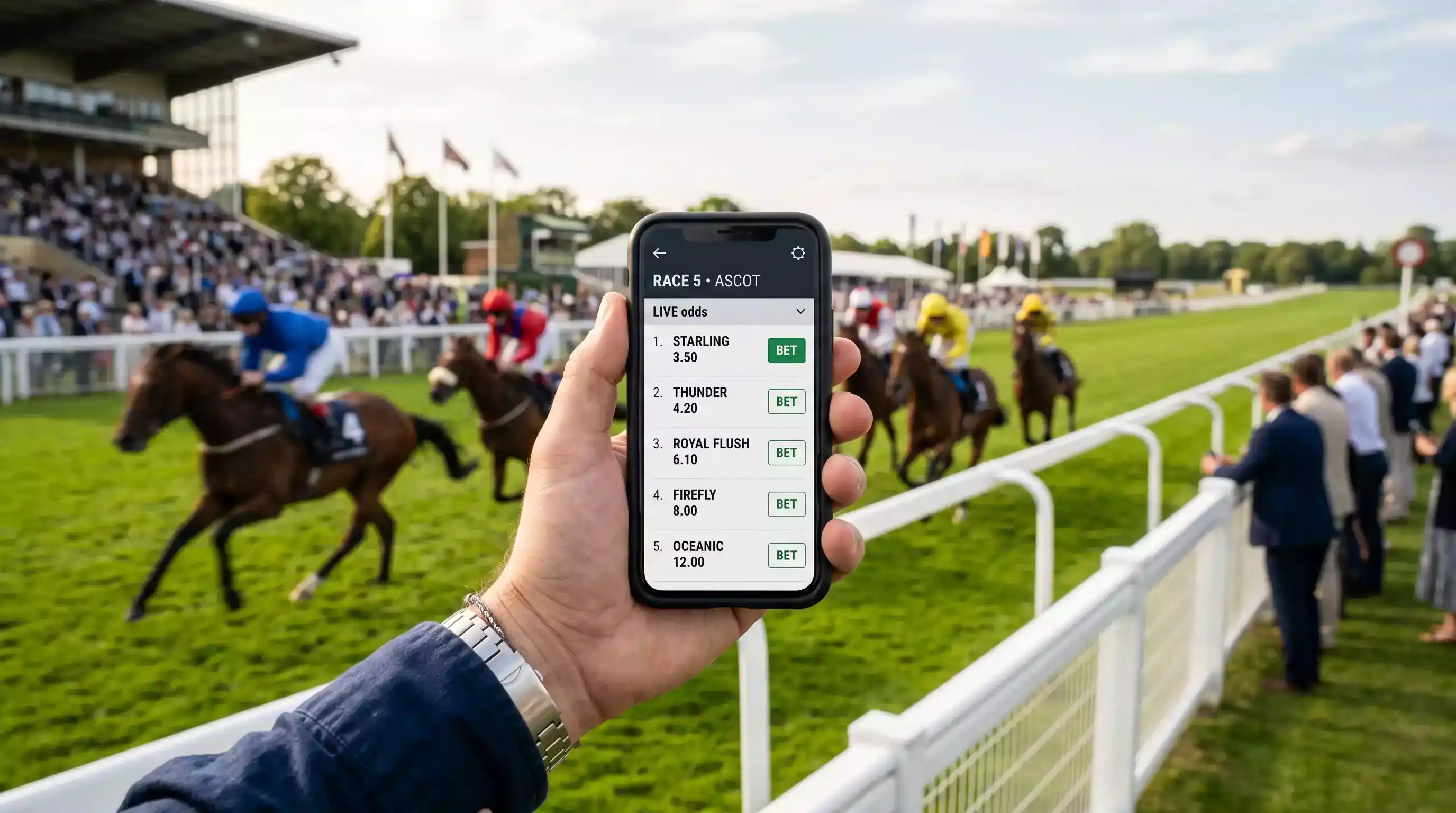
The Grand National is broadcast free-to-air on ITV, which means you do not need a betting site stream to watch it. But there are practical reasons to have the stream running on your betting platform as well. Most operators overlay their live stream with real-time odds, cash-out valuations, and race commentary that integrates with your bet slip. If you are considering an in-play cash out, seeing the race and the live cash-out figure simultaneously makes the decision significantly easier than toggling between a TV broadcast and a betting app.
Stream quality varies. The major UK operators deliver reliable HD coverage, while some smaller platforms offer lower resolution with occasional buffering. Over a nine-minute race, a stream delay of even a few seconds can mean the difference between cashing out at the right moment and missing the window. I test the stream on the earlier Aintree races before the National goes off, and if a platform is lagging, I move my cash-out exposure to an operator with a faster feed.
More than 2.3 million people attended UK racecourses in the first half of 2024, and the Grand National meeting accounts for one of the largest single-event attendances. Whether you are at the course or watching remotely, the streaming and live-betting infrastructure of your chosen operator shapes the experience. Choose a platform that gives you information and optionality, and the race becomes not just a spectacle but a live analytical exercise where every fence cleared shifts the probabilities – and potentially, your returns.
For a wider comparison of how UK operators handle live racing coverage beyond the National, the live streaming guide covers day-to-day differences in access, quality, and minimum-bet requirements.
How many places do bookmakers pay on the Grand National?
It varies by operator. Standard each-way terms pay three places at one quarter the odds, but for the Grand National most major bookmakers extend this to four, five, or even six places. The place fraction may also change – some operators offer one fifth the odds on extended place terms. Comparing place terms across bookmakers before the race is one of the most effective ways to maximise value on Grand National each-way bets.
When do Grand National ante-post markets open?
Ante-post markets for the Grand National typically become active around six months before the race, sometimes earlier for the most prominent contenders. The serious ante-post betting begins after the Cheltenham Festival in March, when the Aintree entries become clearer and trial form is available. Prices in the ante-post market contract as the race approaches and the final declarations narrow the field.
Published by the Horse Racing bet Website team.