Each-Way Betting on Horse Racing: Place Terms, Calculations and Value
 Available in US
The first each-way bet I ever placed cost me a tenner and taught me a lesson worth far more. I backed a 14/1 shot in a sixteen-runner handicap at York. The horse finished third. I assumed I’d lost. Then I checked my account — there was 25 pounds sitting there. The place part of my each-way bet had paid out at a quarter of the odds, and I’d turned what I thought was a losing afternoon into a decent return.
Each-way betting is the backbone of horse racing punting in the UK. It’s the mechanic that lets you back a horse to win and simultaneously insure yourself with a place bet — two bets wrapped in one. But “each-way” is also the most misunderstood term in racing. I’ve spent nine years working through the maths with punters who assumed they understood it, only to discover they’d been miscalculating returns, ignoring place terms, or throwing money at each-way bets in races where the structure killed their edge.
This guide strips each-way betting back to its components, runs the numbers step by step, and identifies where the value genuinely sits. I’ll cover place terms, extra places, common mistakes, and the situations where each-way is a sharp play versus a lazy habit. If you’re betting on horses through any UK horse racing betting site, each-way is a tool you’ll use constantly — so it pays to use it properly.
Table of Contents
- How Each-Way Betting Works: Win Part and Place Part
- Place Terms by Race Type and Field Size
- Each-Way Returns Calculated Step by Step
- Extra Places: How Bookmakers Extend the Place Market
- When Each-Way Betting Offers Genuine Value
- Common Each-Way Mistakes and How to Avoid Them
- Best Bookmakers for Each-Way Terms
How Each-Way Betting Works: Win Part and Place Part
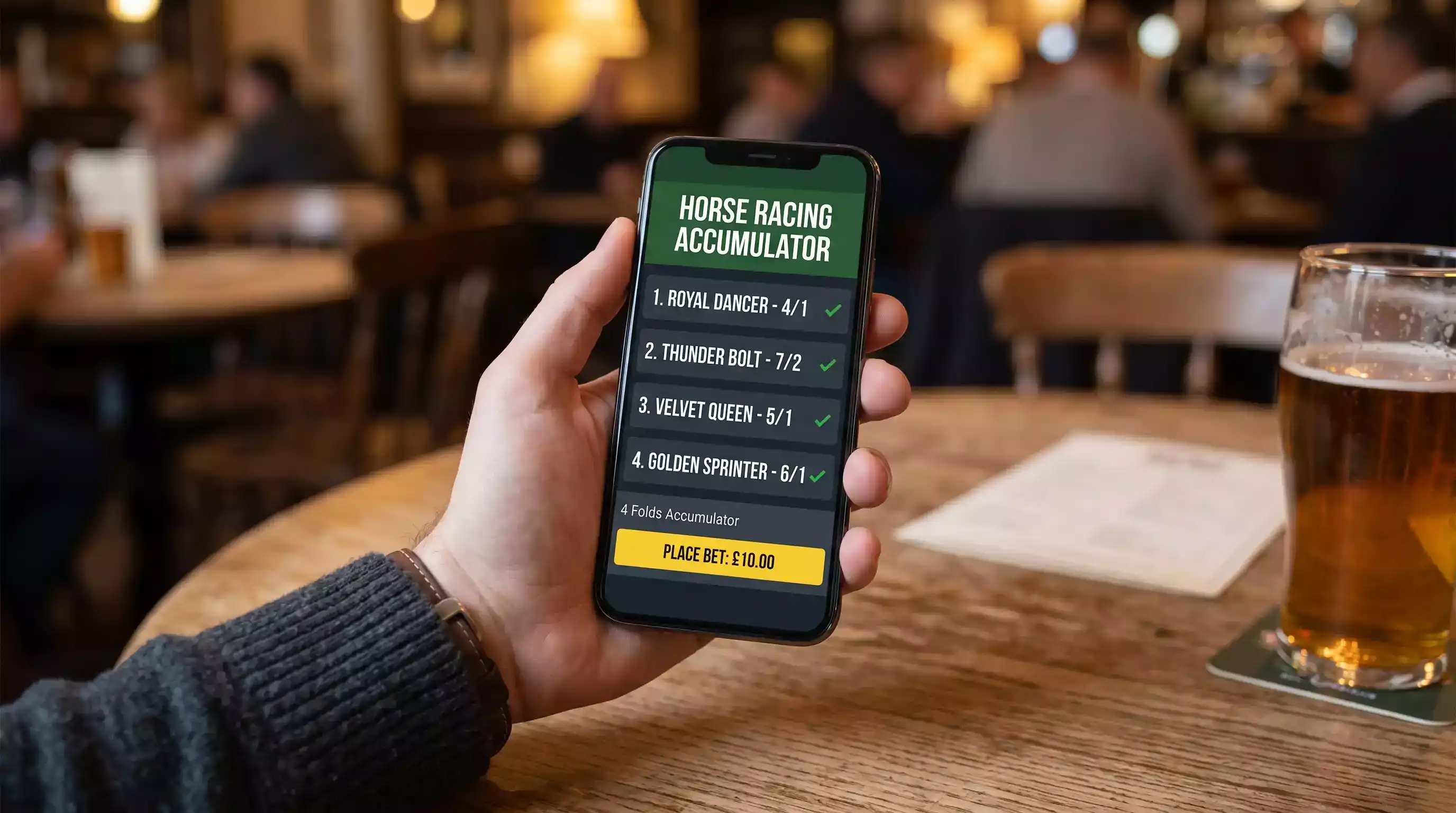
Every time I explain each-way betting to someone new, I use the same line: you’re placing two bets, not one. Your tenner each-way costs twenty pounds. Half goes on the horse to win. Half goes on the horse to place — meaning finish in one of the designated place positions for that race. Two separate bets, two separate outcomes, one bet slip.
The win part is straightforward. If your horse crosses the line first, the win portion pays at the full odds you took. A tenner at 8/1 returns 90 pounds — your 10-pound stake plus 80 pounds in winnings. Exactly the same as a straight win bet.
The place part is where each-way earns its keep. If your horse finishes in a place position — second, third, or sometimes fourth depending on the race — the place portion pays at a fraction of the full odds. That fraction is determined by the place terms, which I’ll break down in the next section. At standard terms of 1/4 odds for a non-handicap race, your 8/1 shot finishing second pays the place part at 2/1 — returning 30 pounds on a tenner stake.
When the horse wins, both parts pay. You collect the full-odds win return plus the place return. When the horse places but doesn’t win, only the place part pays and you lose the win stake. When the horse finishes outside the place positions, you lose both stakes. That’s the complete mechanic — three possible outcomes with three different payoff structures.
The mental trap most beginners fall into is treating each-way as a single bet with a safety net. It isn’t. It’s two bets with different strike rates and different payoffs. The win part hits less often but pays more. The place part hits more often but pays less. Understanding each-way means understanding that trade-off and knowing when the maths favours taking it.
Place Terms by Race Type and Field Size
Place terms are the single most important variable in each-way betting, and the one most punters glance at without truly absorbing. I learned this the hard way at Ascot years ago when I backed a horse each-way in a five-runner Group race, assuming four places would be paid. Only three were. The place terms for that race type only covered first, second and third. My horse finished fourth. Gone.
The standard place terms across UK bookmakers follow a pattern tied to field size and race type. In races with two to four runners, most operators offer win-only markets — no each-way option at all. With five to seven runners, the place terms typically pay on the first two finishers at 1/4 of the odds. Move up to eight or more runners in a non-handicap race and you get three places at 1/4 odds. Handicap races with twelve to fifteen runners usually pay three places at 1/5 odds, and handicaps with sixteen or more runners often extend to four places at 1/4 odds.
Those are the baseline terms. In practice, the fractions and number of places vary by operator and by specific race. Some bookmakers offer 1/4 odds on three places across the board for large-field handicaps, while others drop to 1/5 — and that difference matters more than people think. On a 10/1 shot, the place portion at 1/4 odds pays 2.5/1, returning 35 pounds on a tenner. At 1/5 odds, the same horse pays 2/1, returning 30 pounds. Five pounds less per bet, compounded across a season, adds up to real money.
Festival races and feature meetings often carry enhanced place terms — I’ll cover those under extra places. But for everyday racing, the key discipline is checking the place terms before you click. Every bet slip on every major operator displays the place terms for the race you’re betting on. Read them. A five-runner race with only two places paid at 1/4 odds is a fundamentally different proposition from a twenty-runner handicap with four places at 1/4 odds. Same bet type, wildly different risk-reward profile.
Each-Way Returns Calculated Step by Step
I’m going to run three scenarios from start to finish — no shortcuts, no rounding until the end. If the maths feels tedious, that’s the point. Understanding exactly where your money goes is what separates each-way punters who profit from those who don’t.
Scenario one: your horse wins. You’ve placed 10 pounds each-way on a horse at 12/1 in a sixteen-runner handicap. Place terms are 1/4 odds, four places. Your total outlay is 20 pounds — 10 on the win, 10 on the place. The horse wins. Win part: 10 pounds at 12/1 returns 130 pounds (120 profit plus 10 stake). Place part: 10 pounds at 3/1 (12/1 divided by 4) returns 40 pounds (30 profit plus 10 stake). Total return: 170 pounds on a 20-pound outlay. Net profit: 150 pounds.
Scenario two: your horse places but doesn’t win. Same bet — 10 pounds each-way at 12/1, four places at 1/4 odds. The horse finishes third. Win part: lost. You’re down 10 pounds. Place part: 10 pounds at 3/1 returns 40 pounds. Total return: 40 pounds on a 20-pound outlay. Net profit: 20 pounds. You’ve made money despite your horse not winning — and this is where each-way shines on longer-priced runners.
Scenario three: the break-even calculation. At what odds does each-way start making sense purely as a place bet? If you’re backing a horse that you think will place but probably won’t win, the place part needs to return more than your total each-way outlay. With 1/4 odds place terms, your place part pays (odds/4) times your place stake. For that to cover both your win and place stakes combined, you need the odds to be at least 4/1. At 4/1, the place portion at 1/4 odds is evens — returning 20 pounds on a 10-pound place stake, which exactly covers your total 20-pound each-way outlay. Anything above 4/1, and a place finish puts you in profit overall. Below 4/1, even a place finish leaves you out of pocket.
That 4/1 threshold — or more precisely, the point where the place return exceeds the total stake — is the number I carry in my head for every each-way decision. With 1/5 odds place terms, the threshold moves out to 5/1. The longer the odds and the more places paid, the more forgiving each-way becomes. But on short-priced horses, each-way is almost always a value drain.
Run these calculations on any bet you’re considering. It takes twenty seconds and it will change how you view each-way permanently.
Extra Places: How Bookmakers Extend the Place Market
Extra places might be the most underappreciated promotion in horse racing betting. Every major festival — Cheltenham, Aintree, Royal Ascot, the Ebor meeting — triggers a wave of extra-place offers from bookmakers. Instead of the standard three or four places, operators extend to five, six, or sometimes even seven places on feature handicaps. That extension changes the maths dramatically.
Consider a twenty-runner handicap where the standard terms pay four places. A bookmaker offering six places has just increased the number of paid positions by 50%. Your horse no longer needs to finish in the top 20% of the field to return something on the place part — it only needs the top 30%. In a wide-open handicap where the favourite is 8/1 and half the field has a plausible chance, that extra margin can be the difference between a dead loss and a return.
The way bookmakers structure extra-place offers varies. Some extend the number of places but keep the fraction at 1/4 or 1/5 odds. Others add places but reduce the fraction — paying six places at 1/5 instead of four places at 1/4. The first version is genuinely more generous. The second is a trade-off that looks better than it is. Always check whether the fraction changes alongside the number of places.
I track extra-place offers across three or four operators for every major meeting. It’s common to find one bookmaker offering five places at 1/4 odds while another offers six places at 1/5 odds on the same race. Working out which is better for your specific horse depends on your estimate of where it will finish. If you genuinely think the horse will be in the frame — say, top four — the better fraction matters more. If you’re playing for a longer-priced outsider to creep into fifth or sixth, the extra places matter more.
Extra places are a promotional tool for bookmakers, designed to attract volume around high-profile meetings. They cost the operator money, which means the value is real — but they’re also temporary. Standard daily racing rarely comes with extra-place offers, so treat them as seasonal opportunities rather than a permanent feature of the market.
When Each-Way Betting Offers Genuine Value
Not every race deserves an each-way bet. I’d estimate that across the average daily card, each-way is the right play in maybe a third of races — and a waste of money in the rest. The difference comes down to field size, odds range, and race type.
Large-field handicaps are the natural habitat of each-way value. Sixteen or more runners, four places paid, prices ranging from 6/1 to 25/1 across the field. In these conditions, the place portion of your bet has a realistic chance of returning your total stake even if the horse doesn’t win. Core fixture turnover on everyday racing — the kind of meeting that typically hosts these handicaps — fell 14.4% year-on-year in early 2025, which suggests the wider market is under pressure. But the betting structure of these races hasn’t changed, and the each-way maths remains sound.
Short-priced horses in small fields are where each-way destroys value. Backing the 6/4 favourite each-way in a seven-runner race with two places at 1/4 odds is a classic beginner error. If the horse places but doesn’t win, the place return at 3/8 on a tenner is 13.75 pounds — against a 20-pound total outlay. You’ve lost 6.25 pounds despite your horse finishing second. The favourite would need to win to show any profit, at which point you’d have been better off with a straight win bet at a larger stake.
The sweet spot for each-way value sits in a specific zone: horses priced between 6/1 and 16/1 in races paying three or more places at 1/4 odds. In this range, the place part generates meaningful returns even without a win, and the win part delivers a substantial payout if it hits. Outside this zone — either shorter or longer — the case for each-way weakens, though very long-priced shots in huge fields with extra places remain an exception.
Online horse racing betting generated 766.7 million pounds in GGY in the most recent reporting year. A portion of that comes directly from punters placing poorly structured each-way bets on races where the maths doesn’t support it. Understanding when each-way offers genuine value is one of the simplest ways to keep more of your money on the right side of the ledger.
Common Each-Way Mistakes and How to Avoid Them
Nine years of tracking my own each-way betting — and watching others — has given me a reliable catalogue of mistakes that cost punters real money. Here are the ones I see most often.
Backing short-priced horses each-way. I’ve already covered the maths, but the habit is so widespread it deserves emphasis. If the horse is 3/1 or shorter, a win bet is almost always the better structure. The place part at those odds is too small to offset the doubled stake. I catch myself falling into this trap occasionally and have to actively resist the urge to “insure” a strong fancy. The insurance costs too much relative to the payout.
Ignoring the place terms before betting. Every race has its own place terms, and they change with field size. I’ve seen punters back a horse each-way in a race where only two places are paid — effectively betting at half the place odds they assumed. The five seconds it takes to read the terms on the bet slip saves you from a structural mistake that no amount of form analysis can fix.
Treating each-way as a default rather than a decision. Some punters put every single bet on each-way, regardless of the race conditions. That’s not a strategy; it’s a reflex. Each-way should be a deliberate choice made after assessing the field size, the odds, the place terms, and your confidence in the horse’s chance. If you can’t articulate why this specific race suits an each-way bet, you probably shouldn’t be placing one.
Failing to account for the doubled stake in P&L tracking. Your each-way tenner costs twenty pounds. I’ve met punters who record a “10-pound bet” in their tracking spreadsheet and then wonder why their running total never matches their account balance. Every each-way bet should be logged at its total cost — win stake plus place stake — not the unit amount.
Overlooking dead heats and Rule 4 deductions. When a horse is withdrawn after you’ve placed your each-way bet, Rule 4 deductions reduce your payout. That deduction applies to both the win and place parts. In a sixteen-runner handicap where three horses are withdrawn before the off, the cumulative Rule 4 deduction can chew through a significant portion of your return. And dead heats for a place position split your place payout — another scenario that catches people off guard.
Best Bookmakers for Each-Way Terms
Ben Reilly, the Chief Commercial Officer at Flutter Entertainment, acknowledged something important about the relationship between betting and racing: the two exist in a genuine symbiosis — football may have overtaken racing in absolute terms, but the connection between punters and the sport remains deep. That connection is felt most keenly in how operators structure their each-way terms, because the terms they offer directly shape the value available to racing punters.
The differences between operators on each-way terms are more significant than most punters realise. Some bookmakers consistently offer 1/4 odds on places across all race types, while others default to 1/5 on handicaps with twelve or more runners. That fraction — 1/4 versus 1/5 — is the single biggest variable in your each-way return after the horse’s finishing position and odds.
Extra-place frequency is another differentiator. Some operators run extra-place promotions only on major festivals; others extend them to selected feature races throughout the week. If each-way betting is a core part of your approach, the operator who offers extra places on a regular Tuesday card at Kempton gives you structurally more value than one who only triggers the promotion at Cheltenham.
RCBB operators — the remote casino, betting and bingo sector — held 24.4 million active accounts at the end of the last reporting quarter, with new registrations declining 4.1% to 34 million. In a market where customer acquisition is getting harder, each-way terms are one of the levers operators use to retain punters. The savvy approach is to maintain accounts with two or three operators who offer the best each-way terms for the type of racing you bet on most. If your focus is big-field handicaps, prioritise operators with 1/4 place odds and regular extra places. If you bet primarily on small-field National Hunt racing, the number of places matters less than the fraction.
Compare before you commit. The operator you use for football might not be the best operator for each-way horse racing. Specialising your accounts by bet type is one of the simplest structural edges available.
What are the standard place terms for each-way horse racing bets?
Standard terms depend on the number of runners. Races with five to seven runners typically pay two places at 1/4 odds. Non-handicap races with eight or more runners pay three places at 1/4 odds. Handicaps with twelve to fifteen runners often pay three places at 1/5 odds, and handicaps with sixteen or more runners usually pay four places at 1/4 odds. These vary by operator, so always check the bet slip before placing.
Is each-way betting better value in handicap races?
Generally yes — large-field handicaps with sixteen or more runners paying four places at 1/4 odds create the most favourable each-way conditions. The wider the field, the more likely a well-fancied horse finishes in a place position without winning, and the four-place structure gives you an extra safety margin. Small-field races with only two paid places are the weakest environment for each-way bets.
What happens to the place part of my each-way bet if my horse wins?
Both parts pay. The win portion settles at the full odds and the place portion settles at the fraction of the odds specified in the place terms. So a 10-pound each-way bet at 8/1 with 1/4 odds place terms returns 90 pounds from the win part and 30 pounds from the place part — a total of 120 pounds on a 20-pound outlay.
Written by the editors at Horse Racing bet Website.