How to Read a Horse Racing Form Guide
 Available in US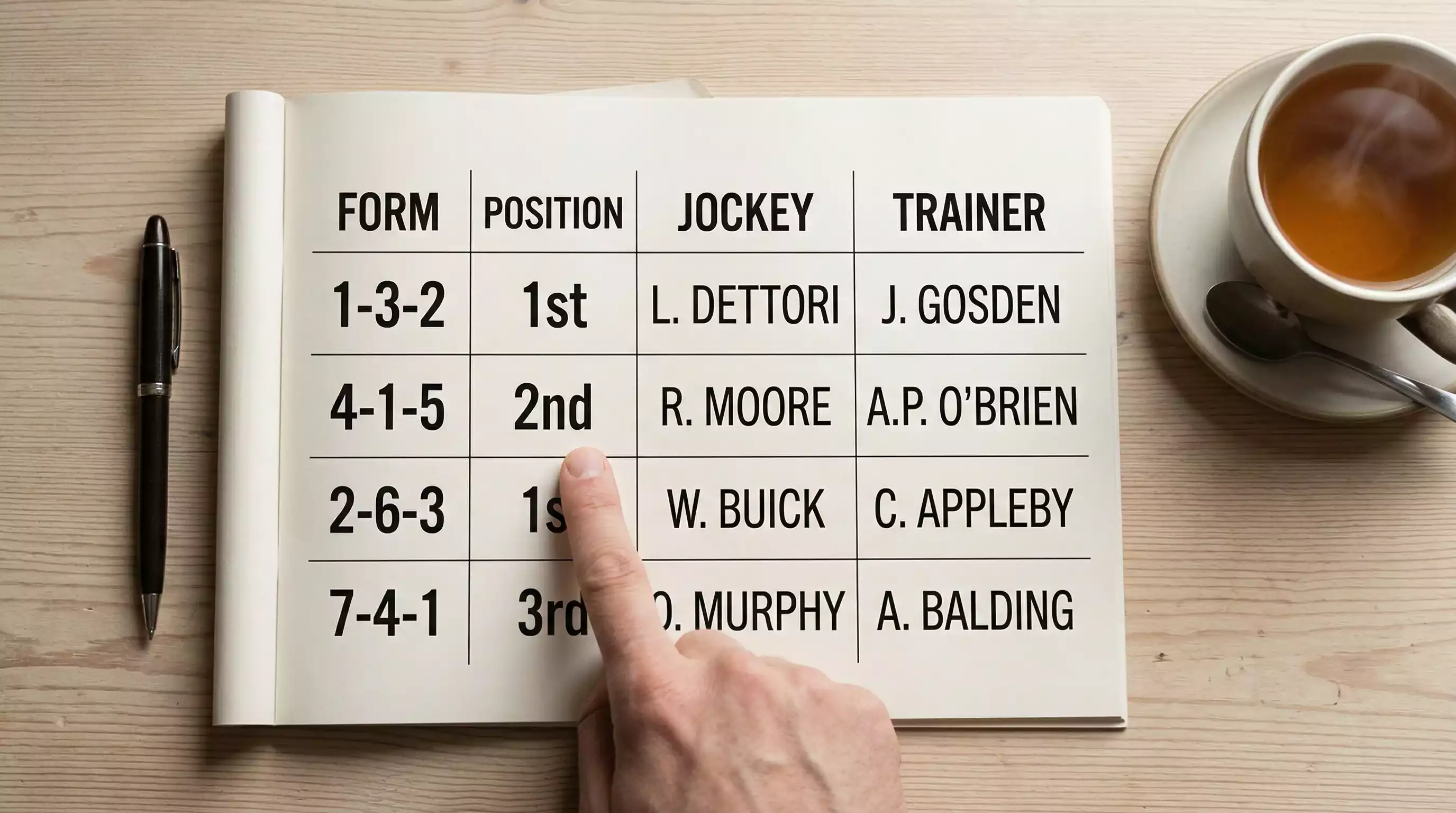
I spent the first two years of my betting life ignoring form. Not deliberately – I just did not know how to read it. The racecard looked like a wall of hieroglyphics, and nothing I found online made the decoding process feel accessible. Then one afternoon at Sandown, an older punter standing next to me at the rail noticed me staring at the racecard and said: “The numbers tell you where it’s been. The letters tell you how it got there.” That sentence unlocked something, and I have read form obsessively ever since. Nine years on, the form guide is the single most important tool in my analysis – more useful than tipsters, more reliable than market movements, and infinitely more valuable than backing horses based on names, colours, or gut feeling.
What the Numbers and Letters Mean
Every horse in a UK racecard carries a form string – a sequence of numbers and letters that summarises its recent racing history. The most recent result appears on the right, and earlier results extend to the left. A form string of 21340 tells you this horse finished second, first, third, fourth, and last time out finished outside the places (0 means unplaced, not zero finishes).
The numbers are finishing positions: 1 means first, 2 means second, and so on up to 9. Any finishing position from tenth onwards is represented by 0. A hyphen (-) indicates a break between racing seasons, usually separating the current season’s form from the previous one. A forward slash (/) indicates a longer gap, typically a year or more. If you see a form string like 11-/213, you are looking at a horse that won twice last season, had a substantial break, and has run three times this season with results of second, first, and third.
Letters carry specific meanings. F means the horse fell (most common in National Hunt racing over jumps). U means it unseated its rider – the horse did not fall, but the jockey came off. P means it was pulled up – the jockey stopped the horse during the race, usually because it was hopelessly out of contention or showing signs of distress. R means it refused – typically at a fence or hurdle. B means it was brought down by another horse’s fall. S means it slipped up on the flat. C means it was carried out by a loose horse.
These letters are not just footnotes. A horse with F in its recent form may have a jumping problem. A horse that was pulled up (P) last time could have been injured, unfit, or simply had a bad day. The context around each letter matters enormously, and it is worth reading the race comments (available on most form sites) to understand why a horse recorded that letter rather than a number.
One more piece of notation: bold type or a specific marker often indicates that the horse won its race. Some form guides also use italics or a different font weight to indicate course and distance winners – horses that have previously won at today’s track over today’s trip. These horses have proven they can handle the specific conditions they are about to face, which is a genuine positive.
Reading Jockey and Trainer Stats in the Form
A horse does not run by itself. The jockey-trainer combination is a critical variable that the form guide helps you assess, though it requires a slightly different lens than reading finishing positions.
Most detailed form guides include trainer statistics: win percentage over the past 12 months, strike rate at the specific course, and recent form (how many winners from the last 14 or 30 runners). A trainer sending out winners at a 25% strike rate is operating at an elite level. A trainer at 5% is either running horses for experience rather than expectation, or going through a rough patch. Neither figure alone tells the full story – a trainer with a 10% strike rate who specialises in 20/1 shots might be delivering better value than a trainer at 20% whose horses are always odds-on.
Jockey bookings can be equally revealing. When a leading jockey takes the ride on a horse that has previously been partnered by less prominent riders, it often signals that connections expect an improved performance. Conversely, when a top jockey is replaced by a conditional or apprentice, it might indicate the trainer is not optimistic about the horse’s chance in this particular race. These are not rules – there are plenty of legitimate reasons for jockey changes – but the pattern is worth noting.
The jockey-trainer combination also matters. Some jockeys have significantly higher win rates with certain trainers, reflecting a working relationship and mutual understanding of race tactics. Form databases that track these partnerships can reveal edges that raw finishing positions alone do not capture.
How Ground Conditions Appear in the Form Guide
Next to each previous run in a horse’s form, you will usually find a notation indicating the going – the ground conditions on the day it raced. This is expressed on the standard UK scale: hard, firm, good to firm, good, good to soft, soft, heavy. In flat racing, you might also see “standard” or “slow” for all-weather surfaces.
Why does this matter? Because some horses perform dramatically better on certain types of ground. A horse with form figures of 1121 might look exceptional until you notice that all four runs were on soft ground, and today’s race is on firm. That same horse might produce a form figure of 0P on firmer surfaces. The numbers alone do not tell you this – you need to cross-reference finishing positions with the going at the time.
I colour-code my racecard notes by going preference. Any horse running on its preferred surface gets highlighted. Any horse running on a surface it has struggled with gets flagged. This simple system catches situations where a horse’s overall form figures look modest but its form on today’s specific going is actually strong – or where a horse with impressive headline figures has never encountered the conditions it is about to face.
Weather forecasts matter here too. The going can change between the morning and the afternoon, particularly during the National Hunt season when rain can transform good ground into soft within hours. I always check the going report on the morning of racing and again close to the first race. A late change in conditions can render your pre-race form analysis partially obsolete, and the punters who update their assessments in real time have an edge over those who looked at the card the night before and did not revisit it.
Turning Form Data Into a Betting Decision
Reading form is one skill. Translating it into a betting opinion is another, and the gap between them is where most punters stall. I have met plenty of people who can recite a horse’s form string from memory but cannot tell you whether it represents value at the price.
My process starts with elimination rather than selection. I look at a race and remove horses whose form, ground preference, or trainer patterns suggest they are unlikely to be competitive. In a twelve-runner handicap, I might eliminate six or seven runners within five minutes. The remaining field is where I focus my analysis – comparing recent form, assessing each horse’s suitability to today’s conditions, and then checking whether the odds available reflect my assessment or offer an overlay.
Richard Wayman, the BHA’s Director of Racing, noted that total betting turnover fell 9% in Q1 2025, with core fixture turnover dropping 14.4% year-on-year. One of the implications of shrinking turnover on everyday racing is that the pricing can become less efficient – fewer bets mean less information flowing into the market, which means more opportunities for a form reader who puts in the work. The big festival meetings still attract enough liquidity to make the market efficient, but a Tuesday afternoon at Catterick or Plumpton? The form reader has an edge that the casual punter does not.
Horse racing betting participation sits at around 4% to 7% of UK adults depending on the season, which tells you that the vast majority of bets come from a relatively small, repeat audience. Within that audience, the punters who read form systematically are a smaller subset still. Being in that subset does not guarantee profit, but it moves you from the category of people who guess to the category of people who assess. Over hundreds of bets, that distinction compounds into a meaningful difference in results.
The form guide is not a crystal ball. It will not tell you who wins – nothing can. What it does is narrow the field, identify patterns, and surface information that the naked eye and the gut cannot access. Every minute you spend learning to read it is an investment in your ability to make decisions that are grounded in evidence rather than hope, and in a market where most participants are operating on instinct, evidence is a genuine competitive advantage when combined with best odds guaranteed.
What does the letter C mean in horse racing form?
The letter C in a horse’s form string means it was carried out – knocked off its intended racing line or forced out of the race by a loose horse or another runner’s fall. It indicates that the horse did not complete the race through no fault of its own, which is important context when assessing its true ability. A ‘carried out’ result should be discounted rather than held against the horse.
How many past races should I look at when reading form?
A minimum of four to six recent runs gives a useful picture, but context matters more than quantity. Look at what the horse has done on similar ground, at a similar distance, and at a similar level of competition. A horse might have ten runs on its record, but only three of them were on ground comparable to today’s conditions – those three are more relevant than the other seven combined.
Prepared by the Horse Racing bet Website editorial staff.