Horse Racing Betting Exchanges: How They Work and When to Use Them
 Available in US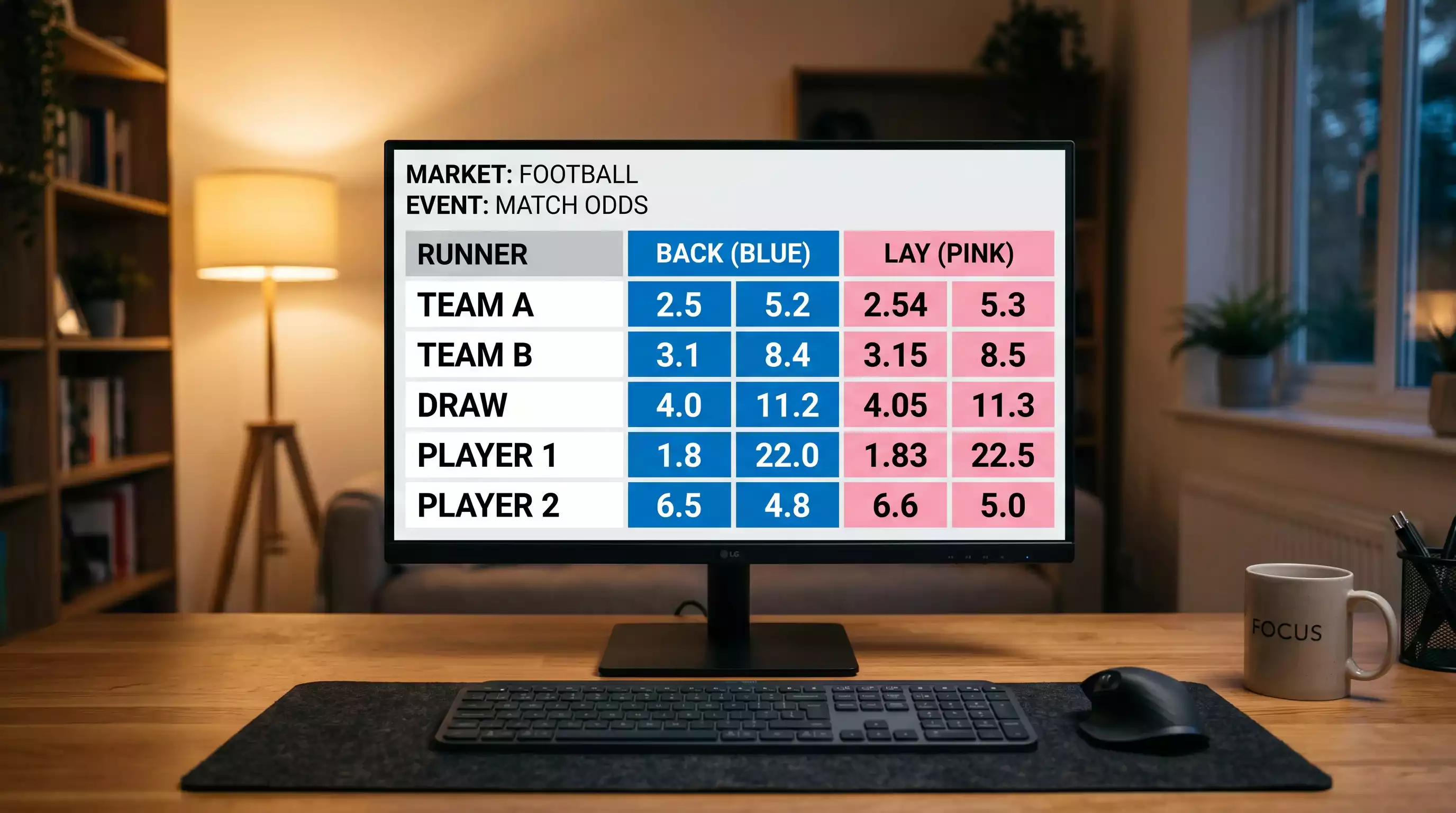
The day I opened my first betting exchange account changed how I think about horse racing betting. Up until that point, I had only ever used traditional bookmakers – you pick a horse, you take the price, you hope it wins. The exchange introduced a dimension I had never considered: you can bet against a horse. You can set your own price. You can trade positions in and out of a race like a financial market. It was disorienting at first, and it took me several months and a few expensive lessons to use it effectively. But exchanges are now where I place the majority of my horse racing bets, and if you are serious about long-term profitability, understanding them is not optional.
How Betting Exchanges Work: Back, Lay and the Spread
A betting exchange is a marketplace where bettors match bets with each other rather than with a bookmaker. Two sides exist for every selection: the “back” side (betting that the horse will win, identical to a traditional bet) and the “lay” side (betting that the horse will not win, effectively acting as the bookmaker).
When you back a horse at 5.0 on the exchange, you are matched with someone who has laid at that price. If the horse wins, the layer pays your winnings. If it loses, you pay the layer your stake. The exchange takes no position itself – it simply facilitates the match and charges a commission on winning bets.
The prices on an exchange are set by supply and demand. If more people want to back a horse than lay it, the back price shortens and the lay price adjusts. If more people want to lay, the prices drift. This market mechanism produces odds that are generally closer to “true” probability than bookmaker odds, because there is no overround built in. The exchange’s profit comes from commission rather than from pricing the market in its favour.
The spread between the back price and the lay price is the exchange’s equivalent of the bookmaker’s margin. On heavily traded markets – a Saturday afternoon feature race, for example – the spread might be one or two ticks (the smallest price increment). On a thinly traded Monday evening race, the spread might be several points wide. The width of the spread tells you how liquid the market is, and liquidity is the single most important factor in determining whether an exchange is the right venue for a particular bet.
Commission Rates and How They Affect Returns
The commission model is the exchange’s business. Most exchanges charge between 2% and 5% on net winnings, though the exact rate varies by platform and by the customer’s activity level. Some exchanges offer reduced commission for high-volume bettors or loyalty-tier customers.
The impact on returns is meaningful but less than it initially appears. A 5% commission on a winning back bet at 5.0 (decimal) with a 10-pound stake works like this: gross profit is 40 pounds, commission is 2 pounds (5% of 40), and net profit is 38 pounds. Compare this with a bookmaker offering the same horse at 4.5 (a typical price reduction reflecting the bookmaker’s overround): the profit from a 10-pound back bet is 35 pounds. The exchange bet nets you 3 pounds more despite the commission.
The maths consistently favours the exchange on horses at longer prices, where the gap between the exchange’s market-efficient price and the bookmaker’s margin-adjusted price is widest. On short-priced horses, the advantage narrows, and the bookmaker – particularly one offering best odds guaranteed – can sometimes match or beat the exchange price after commission.
Horse racing bets at traditional bookmakers carry an effective combined rate of approximately 25% on the operator’s profits (15% General Betting Duty plus the 10% Horserace Betting Levy). This cost is passed through to the punter in the form of wider margins. The exchange, while also subject to taxation on its own profits, passes a lower effective cost to the user through the commission model. This structural cost advantage is one of the primary reasons exchange prices tend to be better than bookmaker prices.
When an Exchange Beats a Bookmaker on Horse Racing
Not every race and not every bet is better placed on an exchange. The situations where the exchange consistently offers superior value have identifiable characteristics.
High-profile races with deep liquidity produce the tightest exchange spreads and the most efficient pricing. The Cheltenham Gold Cup, the Derby, the Grand National, and feature Saturday afternoon races all attract enough exchange volume to make the market competitive with – and usually superior to – bookmaker prices. These are the races where I default to the exchange for back bets unless a bookmaker’s specific promotion (BOG, extra places, money-back special) tilts the value calculation.
Laying – betting against a horse – is exclusively an exchange product. There is no equivalent at a bookmaker. If your analysis concludes that a particular horse is overrated by the market and unlikely to win, the exchange allows you to profit from that view directly. I use laying selectively, primarily on short-priced horses whose odds I believe are too short given the race conditions.
In-play trading is another exchange advantage. The ability to back a horse at one price and lay it at a shorter price as the race develops – locking in a profit regardless of the outcome – is a form of betting that has no bookmaker equivalent. In-play trading requires quick execution, a good read of race dynamics, and access to low-latency streams, but it is the closest thing to “risk-free” profit that exists in horse racing betting.
For the first three quarters of 2025, average betting turnover per race fell 5.8% year-on-year, which means thinner liquidity across the market – including on exchanges. For everyday racing, this declining liquidity sometimes makes the exchange less attractive because the spread is wider and it is harder to get matched at competitive prices. On those occasions, a bookmaker with competitive odds and BOG may be the better venue.
Liquidity: Which Races Have Enough Volume
Liquidity is the exchange bettor’s oxygen. Without it, the prices are wide, the matches are slow, and the theoretical advantage of the exchange model evaporates in practice.
In the UK, exchange liquidity on horse racing is strongly correlated with the profile of the meeting. Major festival races, Group and Graded events, and Saturday feature cards attract the deepest pools. Midweek all-weather fixtures, minor jump meetings, and evening racing at less prominent courses attract significantly less, and the exchange spread on these races can be wide enough to negate the pricing advantage.
My rule of thumb: if the exchange market for a race has less than 50,000 pounds matched across all runners by the time I want to bet, I check bookmaker prices instead. Below that liquidity threshold, the exchange spread is usually too wide to offer a reliable improvement over the best available bookmaker price. Above it, the exchange is almost always the better venue for a back bet at medium to long prices.
The practical takeaway is that exchanges are most useful for the serious horse racing bettor who concentrates their activity on well-traded markets. If you bet primarily on major meetings, feature races, and high-profile handicaps, the exchange should be your primary platform. If you bet across the full breadth of the programme, including low-profile fixtures, you need both an exchange and a portfolio of bookmaker accounts to ensure you can always access competitive pricing. The main guide to horse racing betting sites covers how to evaluate the full range of platforms available to UK punters.
Can I use a betting exchange for each-way horse racing bets?
Traditional each-way bets are not available on exchanges because the exchange model matches individual bets rather than offering composite products. However, you can achieve the same outcome by placing two separate bets: a back bet on the win market and a separate back bet on the place market (where available). Some exchange platforms offer place markets on selected races, particularly those with large fields. The combined cost may be similar to an each-way bet with a bookmaker, but the exchange prices on both the win and place components are typically better.
Is laying a horse on an exchange the same as betting against it?
Yes. When you lay a horse, you are betting that it will not win. If the horse loses, you collect the layer’s stake. If it wins, you pay the backer’s winnings. The maximum liability you face is the lay price minus one, multiplied by the backer’s stake. Laying is the opposite of backing: you profit when the horse fails, and you lose when it succeeds. This allows you to act as the bookmaker on individual selections, which is a powerful tool when you believe the market has overestimated a horse’s chance of winning.
Written by the editors at Horse Racing bet Website.